Photographing Houghton-Douglass Falls
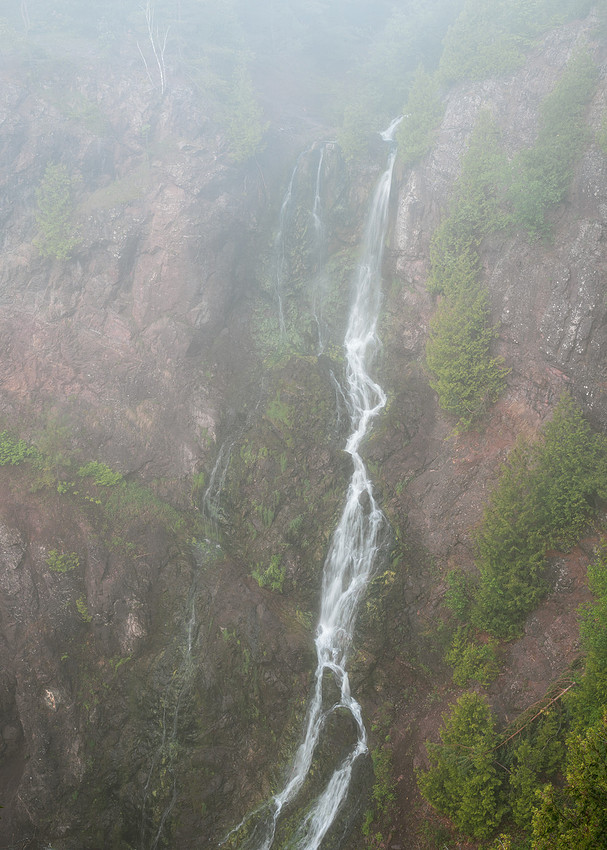
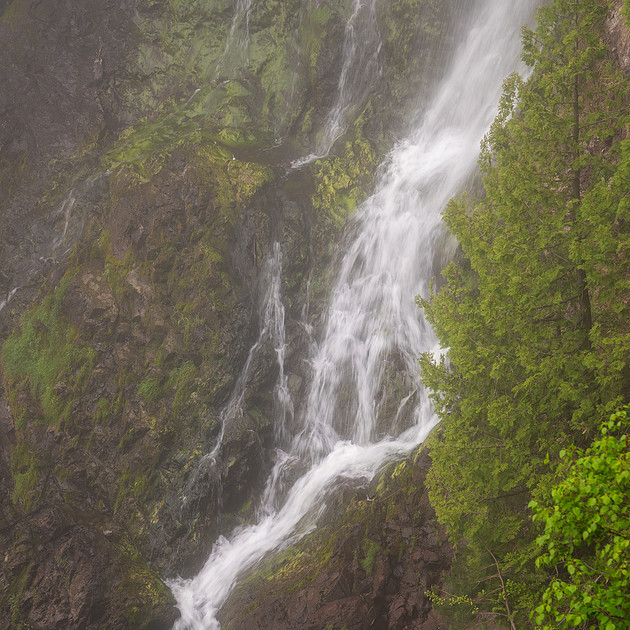
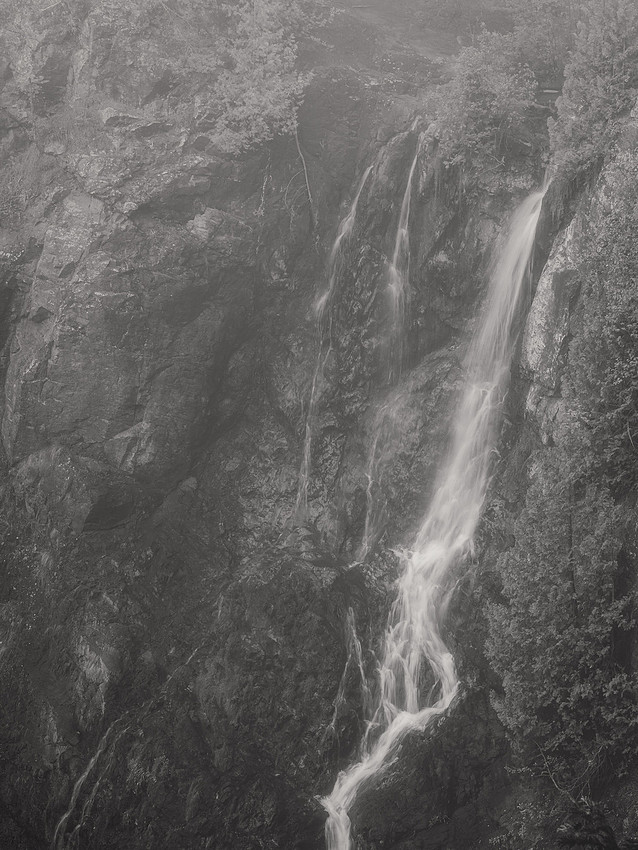
A foggy morning at Michigan's tallest waterfall
At approximately 110 feet tall, Houghton-Douglass Falls is Michigan's tallest waterfall. It's located in the Keweenaw Peninsula along M-26 between Lake Linden and Laurium. Despite living in the area, I had never visited this amazing waterfall before. Accessibility had always been difficult along safety concerns, and getting a good view of the falls from above seemed impossible. The area has been notorious over the decades with some people falling and needing rescuing or even resulting in death, so much so that the landowner cut off public access. That has changed in recent years.
Michigan's Department of Natural Resources purchased the property a few years back and developed the area last year allowing for easy public access. Improvements include a parking area with a vault toilet. A nice gravel trail includes a bridge crossing Hammell Creek. The trail takes you to the north of the waterfall along the canyon's edge. A lesser developed trail continues on and eventually leads to a few viewing areas that allow for an unobstructed view looking back at the waterfall. While these spots are convenient, there is nothing preventing you from falling over the edge of the cliff if you get too close. Safety should be a priority.
The weeks leading up this early June visit had been fairly dry so I knew the water wouldn't be flowing very well. Knowing that, i wanted to photograph the falls on a foggy morning so there would be some nice atmosphere allowing for some unique photos. The fog that was forecasted that morning materialized and I am pleased with the resulting images.

Waterfall Photography at Duppy Falls
A series of three waterfalls on the Jumbo River in Michigan's Upper Peninsula.
The Jumbo River flows within the Ottawa National Forest, in the northwest corner of Iron County in Michigan’s Upper Peninsula. Duppy Falls is a series of three drops as the river cascades over volcanic rock. The waterfalls and the river will be attractive to any photographer willing to go a little out of the way to a place not frequently photographed.
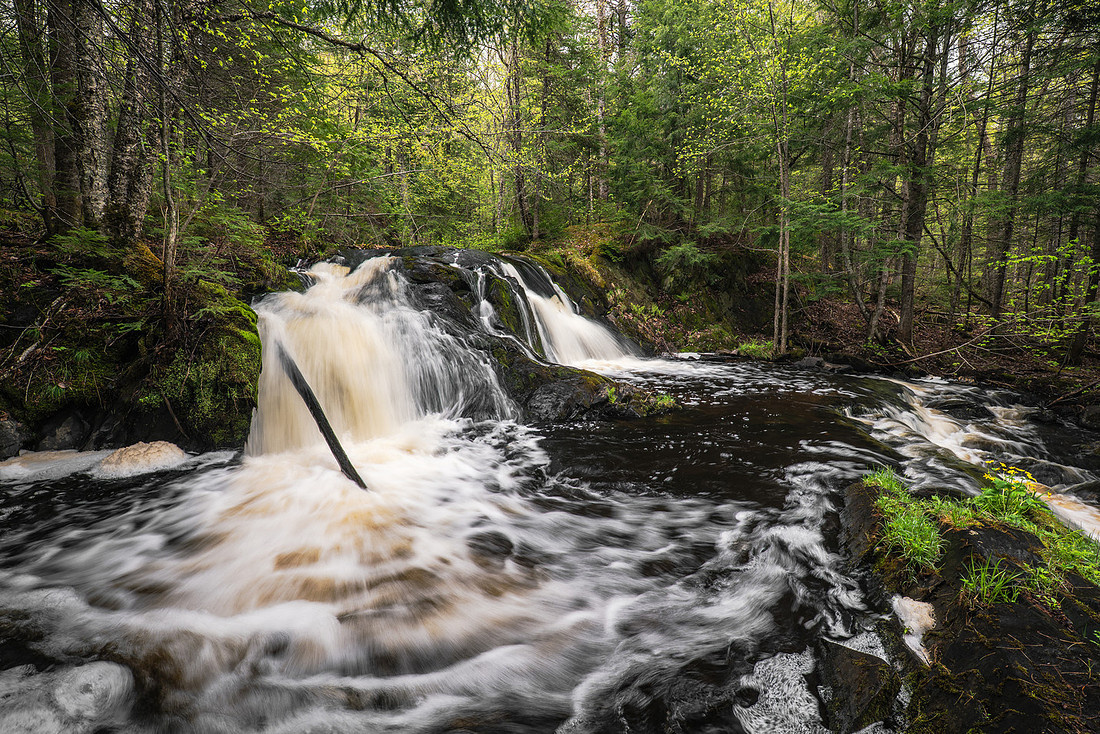
Finding Duppy Falls can be a little difficult. About 5.1 miles south of Kenton on FFH16 there are two narrow two track roads right after each other on the right side. It’s easier to take the second road as the first one is steeper and much more grown in. Head down the narrow road a few hundred yards and park in a large clearing. A well traveled path heads west, crossing the small Slate Creek (there’s a board to walk across the creek). Follow the path upstream a short ways before arriving at Lower Duppy Falls.
 Lower Duppy Falls
This visit was in mid May a few days after some decent rainfall so the river was running a little high. I wanted to cross the river to get a better perspective of this lower section, but the river was running too high to chance it wearing my Muck boots.
The trail continues on, up and around the lower falls to Middle Duppy Falls. The river in this middle section cascades over a drop before making almost a 90 degree turn heading down stream over a smaller angular drop. While not allowing for much room to maneuver, the bank near the small angular drops provides a nice composition of the entire section with the angular drop making for a nice foreground.
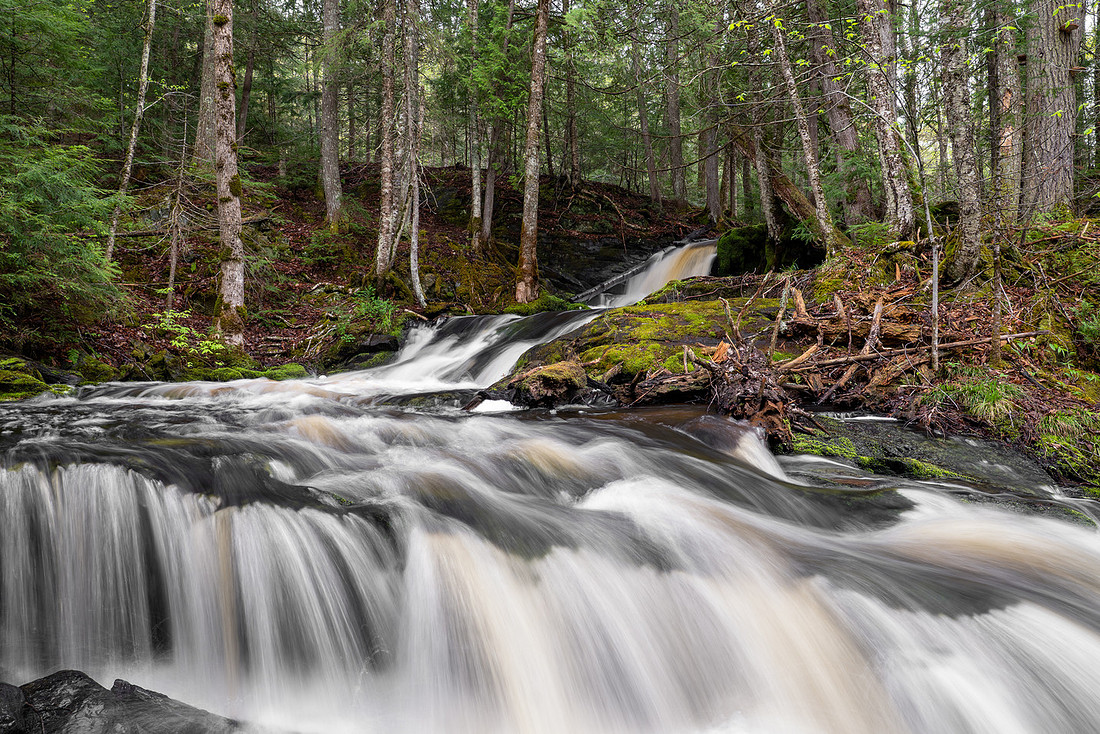 Middle Duppy Falls
Along the bank high above the 90 degree section in the river you are afforded a straight on view of the upper half of the middle falls. This spot also doesn’t allow for much variability in compositions as the river is about 20 feet straight down and the spot is flanked by trees.
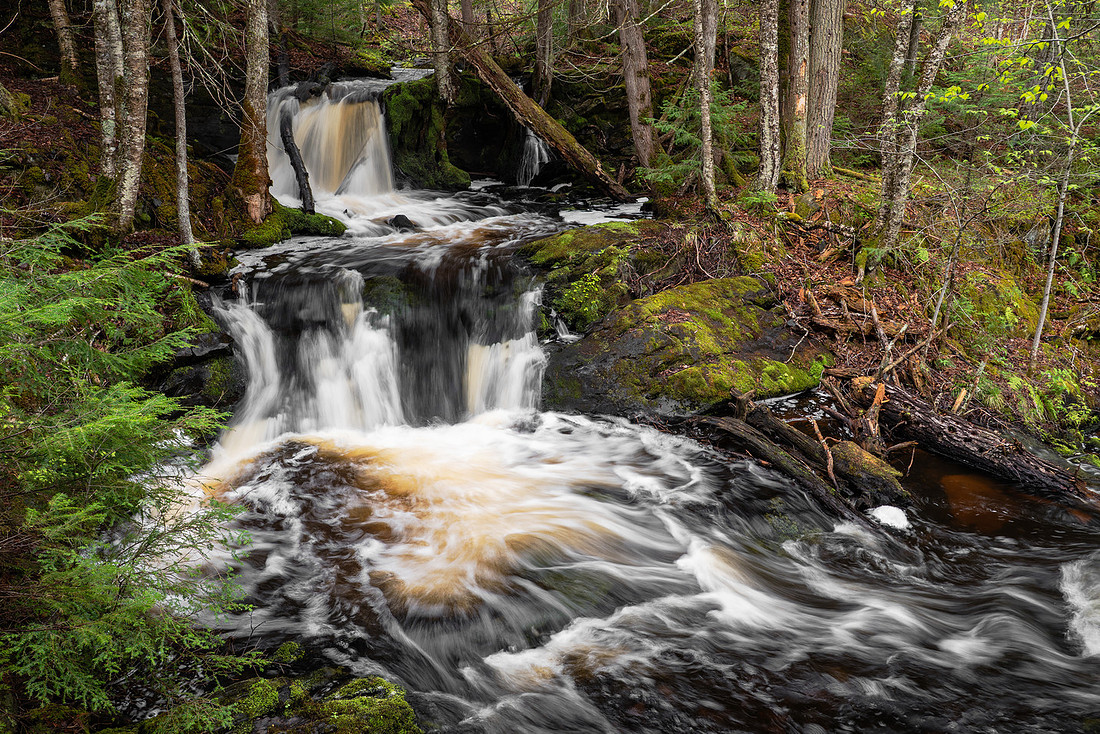 Upper Section of Middle Duppy Falls
The trail continues on for a bit, up and around the upper section of the middle falls. At Upper Duppy Falls the Jumbo River splits into two separate drops next to each other, or at least it does if the water lever is high enough. The two sections converge into a small pool.
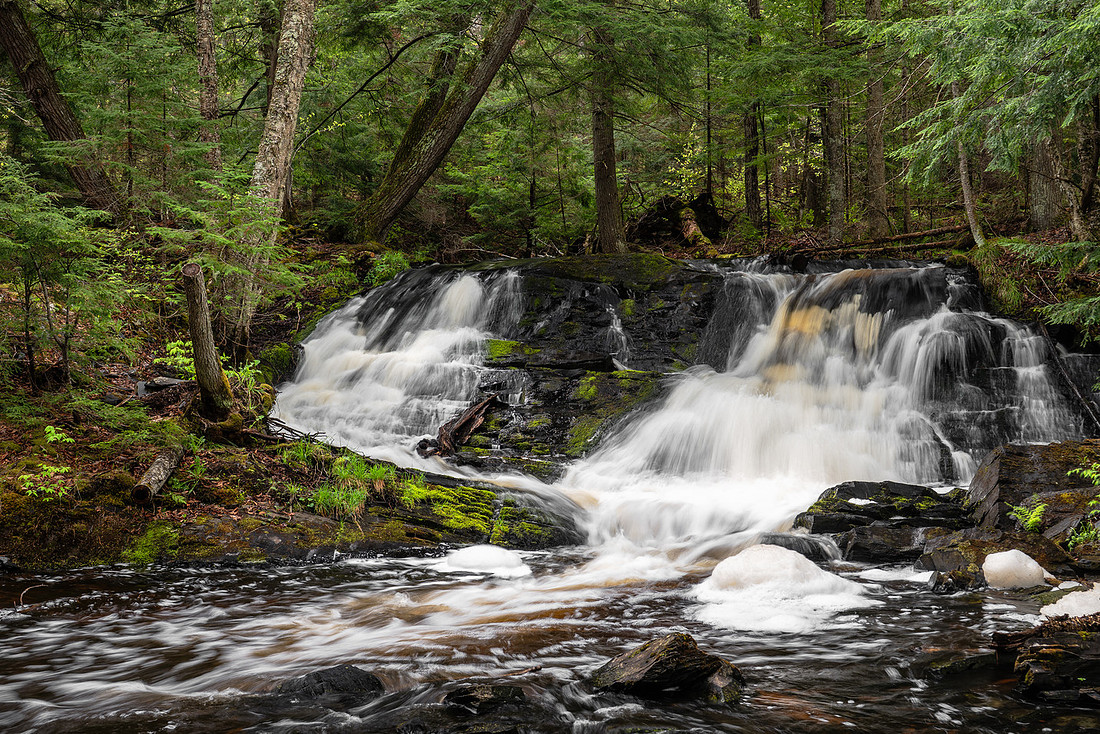 Upper Duppy Falls
Duppy Falls is a place I’ve wanted to visit for a few years now and it didn’t disappoint. The seemingly idyllic setting of each of the drops offers numerous photographic opportunities. Lower water levels would allow for finding different compositions. Some call Duppy Falls a hidden gem in the western Upper Peninsula and I would have to agree. It’s a little difficult to find and can be a bit of drive from most popular locations, but you are rewarded with a beautiful location that will want you making return trips again and again.
I’ve also put together a short video on Duppy Falls…
Large Format at Hungarian Falls
One of my favorite things to photograph is waterfalls, and I'm lucky enough to live in Michigan's Upper Peninsula where there are hundreds and hundreds of waterfalls. Fortunately, the Hungarian Falls Nature Area is just up the road from me, so it's one of my most frequented places to capture waterfalls images. Once I started photographing with large format 4x5 film last year, it was only a matter of time until I visited one of my favorite locations.
A late arriving winter in 2020 meant I was able to visit Hungarian Falls in early December before the deep snow came and the waterfalls froze over. We did have some snow on the ground to provide a nice covering, and the falls were starting to freeze up as winter began to set in. Luckily there were nice ice formations in the pool below Middle Hungarian Falls to provide some foreground interest.
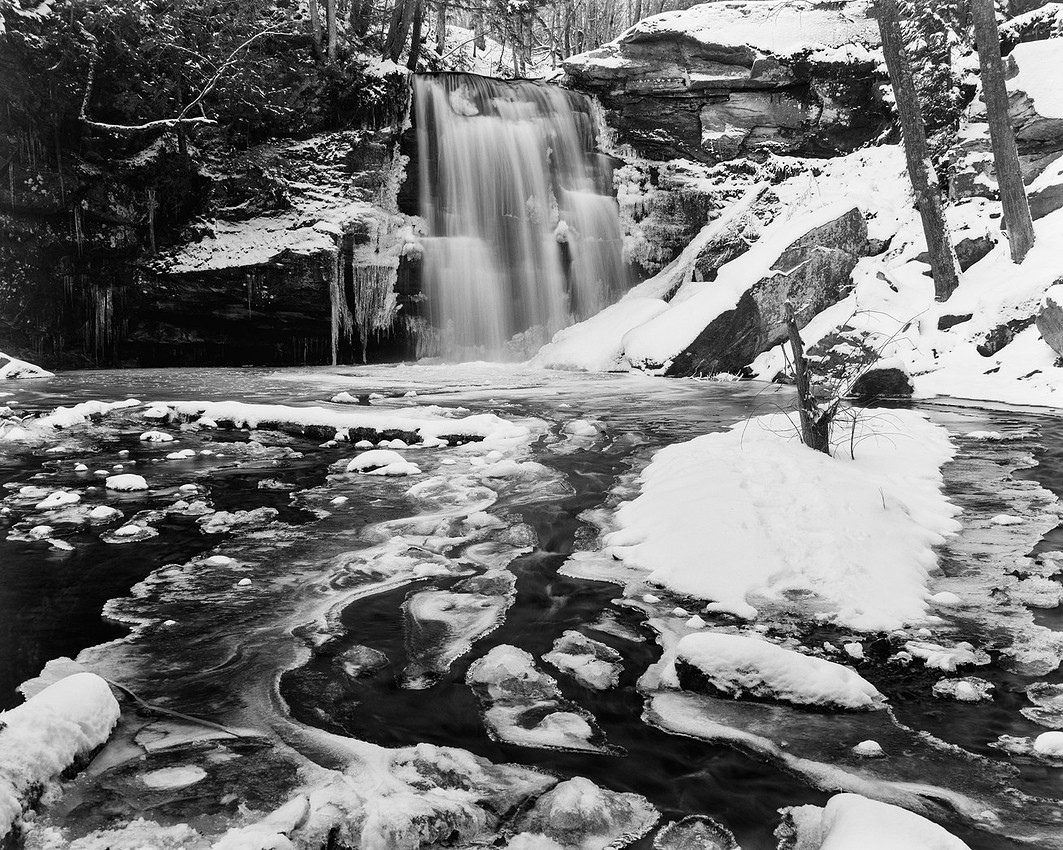
Middle Hungarian Falls
Toyo 45AII, Schneider-Kreuznach Symmar 135mm lens with a polarizer, 1 second at f32, Ilford Delta 100, developed in D76 1:1.
Recently, in the Spring of 2021, I visited Upper Hungarian Falls. I waited until late May for the Spring foliage to arrive and until we had some decent rainfall so the falls were flowing nicely. It also happened to be a cool 40 degree morning which meant the mosquitos weren't the nuisance they can be this time of year.
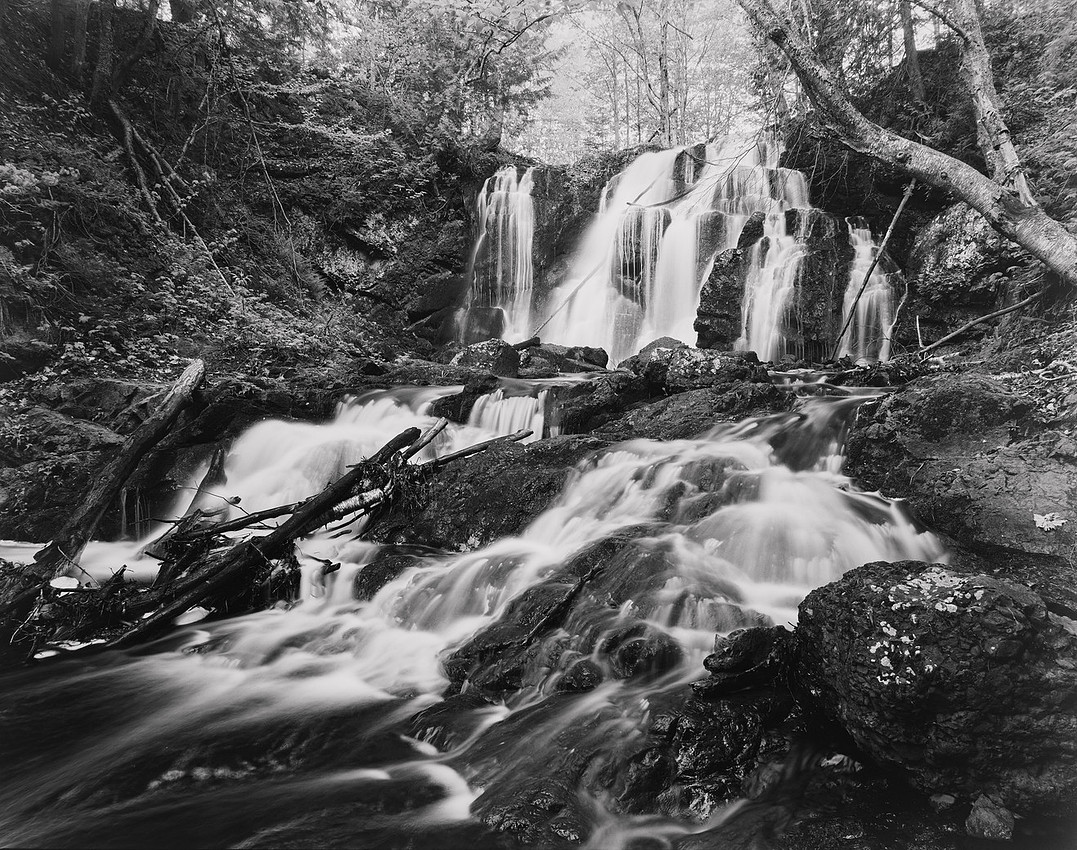
Upper Hungarian Falls
Toyo 45AII, Fujinon SW 90mm lens with polarizer, 4 seconds at f32, Ilford Delta 100, developed in ID-11 1:1.
Before leaving, I stopped by Middle Hungarian Falls for a composition I had in mind. Along the upper bank of the river near the middle falls is a large White Pine tree that acts as a natural frame of the waterfall. I've photographed the middle falls from this spot before and it makes for an interesting and unique image.
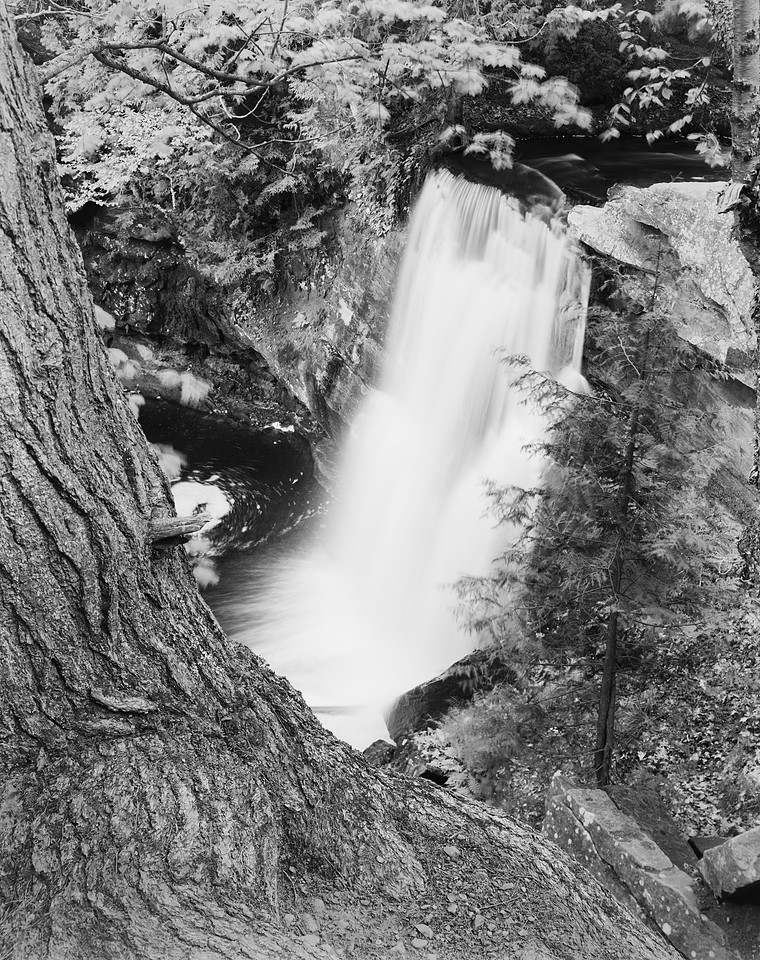
Middle Hungarian Falls, from above
Toyo 45AII, Fujinon CM-W 150mm lens, 2 seconds at f45, Ilford Delta 100, developed in ID-11 1:1.
Going Analog in a Digital Age - Large Format Photography
In 2020 I decided to take the plunge and get a large format 4x5 film camera. Film photography seems to be going through a bit of a resurgence right now, and I suppose I've been caught up in it, but it's something that's always been intriguing to me, but also intimidating at the same time. This is not meant to be a comprehensive guide to large format, but rather some of my general thoughts and observations after doing it.
Making a film image is a very deliberate and slow process, with many chances along the way to make mistakes that can't be fixed. Setting up and taking the shot is very much process driven. This deliberate nature of large format appeals to me because it forces you to slow down and really focus on your composition, lighting and settings. Those are things that can only make you a better photographer. On the other hand, this process presents many opportunities for mistakes and with 4x5 sheet film not being cheap, that's something that gave me pause. It turns out my apprehension was misguided and I quickly gained confidence in the process after a few images. It's fairly straight-forward and intuitive to any photographer but does require your full attention to avoid simple mistakes.

My large format camera - a Toyo Field 45AII, shown with a Schneider Kreuznach Symmar-S 210mm f5.6 lens. Photo by Tom Spurr.
I started out by shooting black and white film because I got a box of expired Ilford Delta 100 and Fomapan 400 included with the camera. Since black and white film is easier to develop than color negative or slide film and I was using expired film, I decided to try developing it myself. Developing film was another area that gave me pause because it seemed complicated with chemicals involved and being yet another step along the way to make a mistake. I don't have access to a darkroom nor the space to build one, so I knew I would have use a tank development system. After some research, I decided that the SP-445 processing system by Stearman Press was the way to go. It's relatively inexpensive and uses very little solution making it quite economical. Much like taking the image, developing the film is also a process. It's very much like following a recipe with a set order of chemicals, temperature and time to follow, with allowance for variations. I've found the SP-445 very easy to use and have had good results so far with my own developing.
So now I have my film negative - what's next? Since I don't have access to a darkroom, I can't make prints. That leaves scanning to get a digital version of the negative. Instead of purchasing an expensive Epson scanner for scanning large format film, I decided to try DSLR scanning since I can just use my digital camera. I use my Panasonic S1 mirrorless camera on my tripod pointed down at a lightpad to take a picture of the negative. A copy stand would be better to use, but I don't have one. One of the keys to DSLR scanning is to have the film negative elevated and held flat above the light source. I found a great product called the pixl-latr that holds the film and diffuses the backlight to allow for easy digitizing.
There's no better time than now to get into large format film photography. There's a wealth of knowledge and videos online to learn from and used equipment is plentiful, though prices have been going up with the renewed interest. The UK company Intrepid Camera provides an inexpensive option for those looking for a new camera. Tank development systems by companies like Stearman Press and Jobo makes home development easy without the need for a darkroom, and products like the pixl-latr make digital scanning easy without a dedicated scanner.
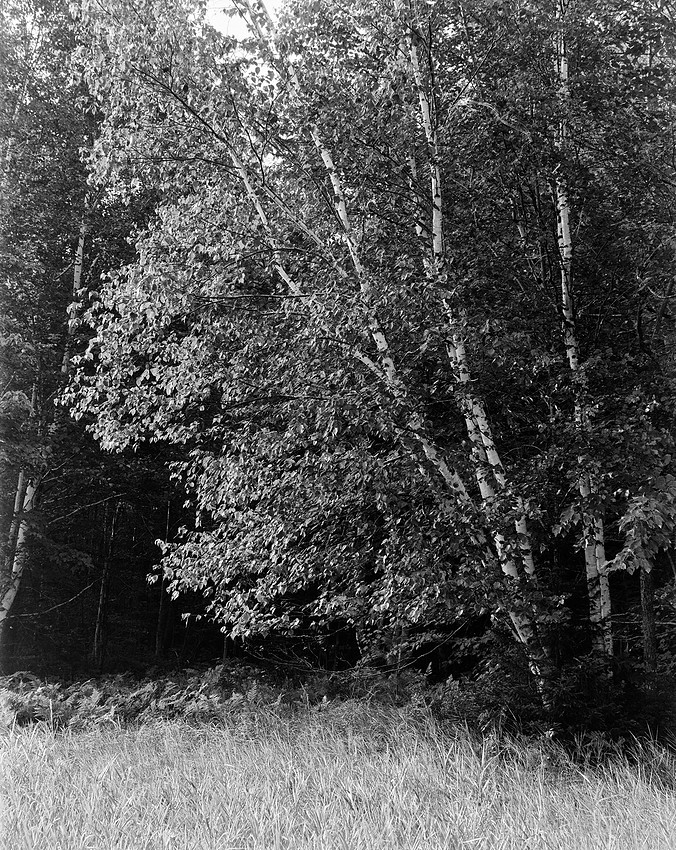
My first 4x5 image, a birch tree in the morning sun in early Autumn.
Toyo 45 AII. Schneider Kreuznach Symmar-S f5.6 lens. F22 at 1/8s. Ilford Delta 100 film developed in Kodak D76 1:1.
Wyandotte Falls - A Hidden Gem in the Copper Country.

Wyandotte Falls is tucked away on the Misery River in Twin Lakes, less than a mile from M26. It seems to be one of the lesser known waterfalls in the area, probably because it's not near any other popular waterfalls and can be somewhat seasonal. The Misery River flows out of Lake Roland, one of the Twin Lakes, and eventually makes its way to Lake Superior. Before reaching the forested area where the waterfall is, the Misery River moves slowly through a wetland area with several small ponds. The size of the waterfall is very dependent upon ample precipitation or snow melt. In dry summer months, it can dry up to barely a trickle.
Getting to Wyandotte Falls is very easy. From M26, turn west onto Poyhonen Road. Going past the golf course, the black top will end. Travel another 275 yards and there will be a small area to park on the left side. Follow the well worn path through the forest along the river to the falls. The hike takes 5-10 minutes and the river provides several photographic opportunities along the way.
 The Misery River along the path to Wyandotte Falls